If you see any stray IMAP folders that are greyed out in Thunderbird, these may be folders that no longer exist on the mail system but they show up in your client as dead folders. These may be due to synchronization issues between multiple clients. Follow these steps to clear it
Continue reading Thunderbird phantom or non-existent foldersCategory: PSMailbox FAQs
Questions about using your PSMail account and correcting issues related to specific services (i.e. “Accessing PSVPN through a proxy” “Why are my outgoing messages failing to send from iMail [MAC OS X]?” etc.)
Switching from POP3 to IMAP without loosing emails
If you have been using the POP3 protocol to collect email for a long time and would like to move to IMAP to support multiple machines or to ensure that your messages are preserved on the server, here are the steps you should take (NOTE: more on the relative advantages and disadvantages of each protocol here):
1. Create a new IMAP account on the same computer with the same email client that you currently use with POP3. Don’t delete your current POP3 account.
2. Ensure the new IMAP account can send and receive emails.
3. Disable but do not delete the POP3 account. In most email clients you can do this by selecting “Do not include this account when sending and receiving.” If there is no such option, just enter an incorrect password in the POP3 account to prevent it from collecting any more emails while the IMAP account is still functional.
4. Drag and drop emails from specific folders (Inbox, Sent, etc.) in your POP3 account to related folders (Inbox, SENT-ITEMS, etc.) in your IMAP account.
5. After the copy operation is complete, ensure that all emails actually copied and are complete. You can check this by closing your email and logging into your PSMail account via your browser at https://mail.psmail.net/dashboard/.
6. Go ahead and delete the POP3 account on your email client.
You’re finished! If you have any questions about this process or need further guidance, please contact our helpdesk here and we’ll be happy to help!
Repeatedly downloading messages when using POP3
PSMail allows our users to choose between IMAP and POP3 protocols. Each has its own specific advantages and disadvantages (see a more detailed comparison here), but if you’ve chosen POP3 there is a specific complication that may arise concerning repetitive email downloads. Typically with POP3, messages are stored on our server only until you access them. At that point, they move to your device and are deleted from our server. However, if you’ve selected to store messages on the server, there is no reliable way in this protocol to identify unique messages (in other words, which messages are new and which are old), so every time you get your messages from the server, it will download every message, whether or not you’ve already downloaded it before. It will continue to do this every time you retrieve messages.
Typically the reason to stick with POP3 is that you would not like messages kept on our server. If you want to keep the messages on the server (and be able, therefore, to access them from multiple devices) then IMAP is the right and reliable protocol to use.
For users who have faced this problem when downloading messages from the server, we recommend that you switch your email client setup to IMAP and afterwards entirely remove POP3 with the “save on server” option from the email client. You may need to retain current POP3 settings while also copying the “Sent” folder (or other local folders) to a server based folder accessible via IMAP.
What is the Virtual Mailbox?
Do you ever wish you could view all your email, from all your various folders, in one place? Have you ever saved an email to a specific folder, on a specific account…but can’t remember where you put it? PSMail’s new Virtual Mailbox aims to solve these common frustrations and simplify your email experience.
How do I view inline images in a email -webmail
When you use PSMail’s webmail, by default all inline images inside an email you received is hidden for security reasons. This can be inconvenient or annoying when you want to read an email where the sender is describing an embedded picture. Continue reading How do I view inline images in a email -webmail
How do I update iPhone’s outgoing settings
When you update your PSMail password, your iPhone may stop being able to send messages. You need to manually update outgoing settings if you use IMAP or POP3 to ensure they are current. Note: Your incoming settings for IMAP/POP3 are different from your outgoing settings. Continue reading How do I update iPhone’s outgoing settings
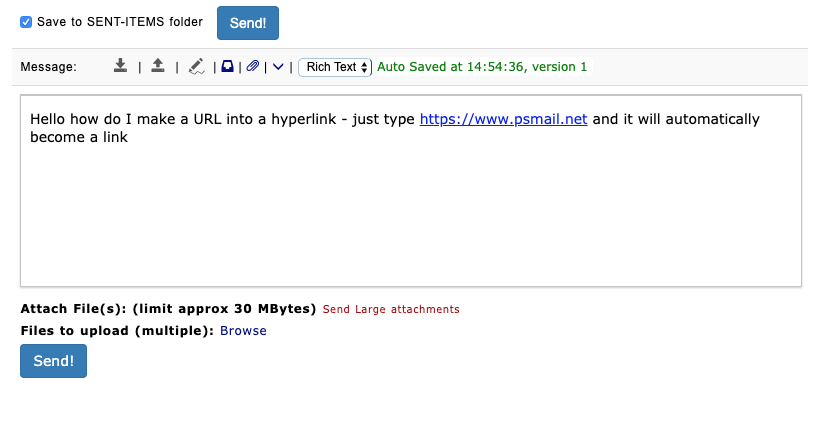
Inserting a hyperlink into email when using webmail
To insert a hyperlink in email, just type out the link or copy and paste the link into email. The system will automatically convert it to a hyperlink. Note when you copy and paste you may need to either type Space or Enter keys to activate the link
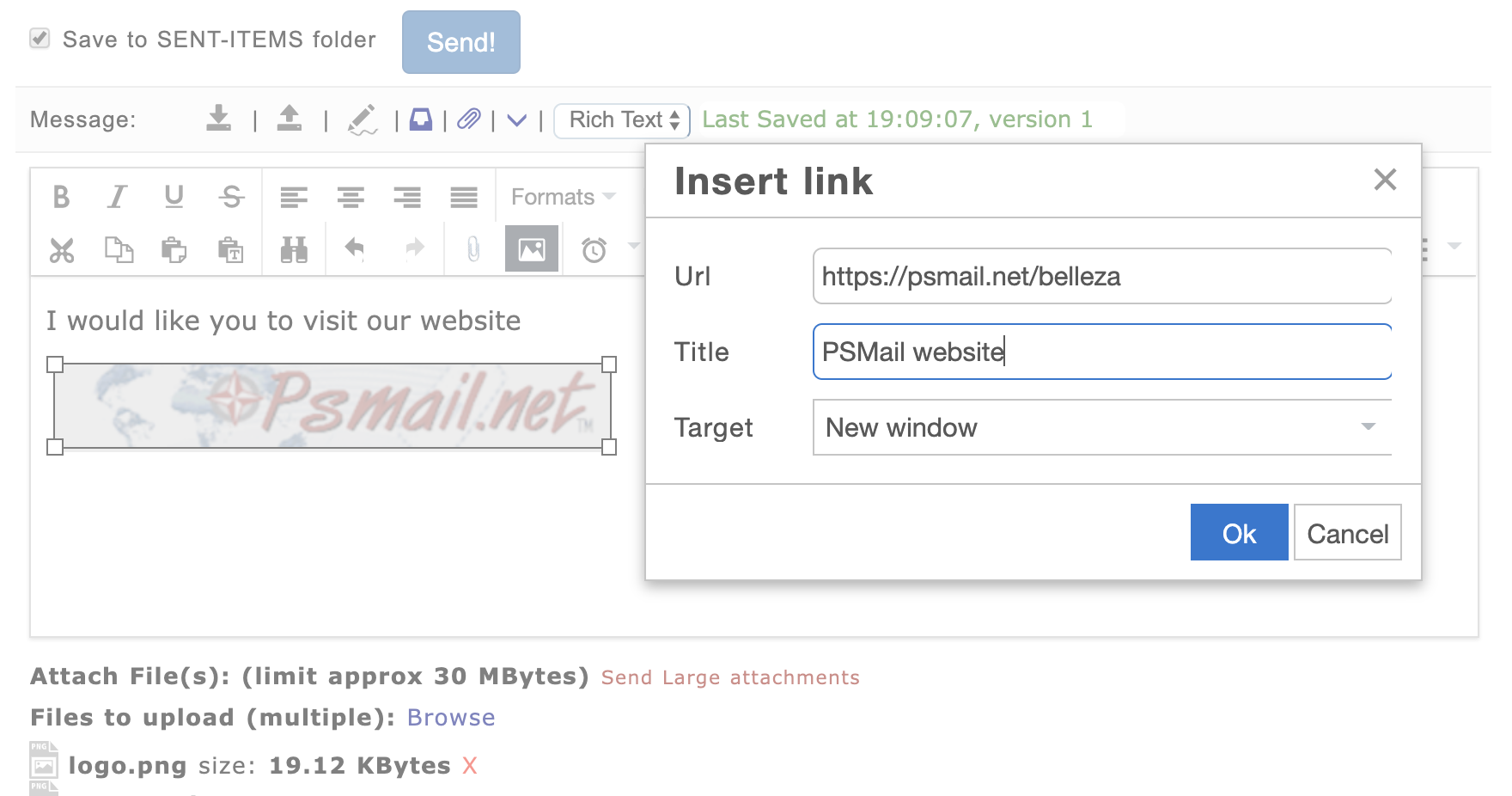
To insert hyperlinks from a picture or a custom text, select the picture or custom text and then use Command-K in Mac or Ctrl-K in Windows to activate the link. The link will be prompted and you can enter the full URL provide custom attribute like “Title” which will be visible on mouse over the link event and “Target” which is safe to leave it as “New Window”. See screenshot below for details
Authentication Error: Username update
If you are experiencing errors when using your email client, please make sure your email client is updated and setup to use your primary email address as the username.
Why does AnyVPN fail on Windows 10?
Anyconnect stopped working after my upgrade to Windows 10, what should I do?
Cisco’s anyconnect has some comptibility issues with Windows 10 upgrade process. Here are the steps that were shown to work on a Windows 10 build of 2015.
How can I do spell check when using webmail?
Ever wonder if you spell receive or recieve when composing an email? When you are using webmail*, PSMail’s email composer allows you to use native browser’s spell check in your local language. All you need to do is enable your browser’s spelling check function (usually under your browser’s Preferences/Options). If your spellcheck is enabled, you will see misspelled words in red color and underlined.
Continue reading How can I do spell check when using webmail?